Java中super和this的用法詳解
super 用法super關(guān)鍵字用來(lái)訪問(wèn)父類內(nèi)容,具體用法可分為三種:1.子類的成員方法訪問(wèn)父類的成員變量
public class Animal { public int age = 10;}class Dog extends Animal { public int age = 5; public void showAge() { System.out.println(super.age); }}
2.子類的成員方法訪問(wèn)父類的成員方法
public class Animal { public void fn(){ System.out.println('父類Animal的方法'); }}class Dog extends Animal { @Override public void fn() { super.fn(); System.out.println('子類Dog的方法'); }}
3.子類的構(gòu)造方法訪問(wèn)父類的構(gòu)造方法
public class Animal { public Animal() { System.out.println('父類Animal的構(gòu)造方法'); }}class Dog extends Animal { public Dog() { super(); System.out.println('子類Dog的構(gòu)造方法'); }}
this 用法this關(guān)鍵字用來(lái)訪問(wèn)本類內(nèi)容,具體用法可分為三種:1.本類的成員方法訪問(wèn)本類的成員變量
public class Dog extends Animal { public int age = 1; public void showAge() { int age = 3; System.out.println(age); System.out.println(this.age); }}
2.本類的成員方法訪問(wèn)本類的另一成員方法
public class Dog extends Animal { public int age = 1; public void showAge() { int age = 3; System.out.println(age); System.out.println(this.age); } public void fn() { this.showAge(); }}
3.本類的構(gòu)造方法訪問(wèn)本類的另一個(gè)構(gòu)造方法,此時(shí)this(…)調(diào)用必須放在這個(gè)構(gòu)造方法中的第一句,且只能使用一次
public class Dog extends Animal { public Dog() { this(2); System.out.println('無(wú)參構(gòu)造'); } public Dog(int age) { System.out.println(age); System.out.println('有參構(gòu)造'); }}
super和this內(nèi)存圖解
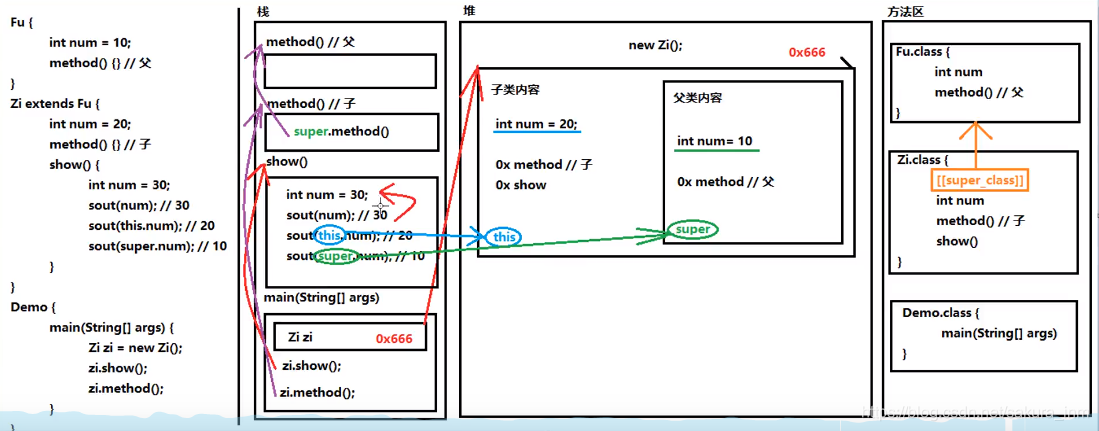
總結(jié)
到此這篇關(guān)于Java中super和this的用法的文章就介紹到這了,更多相關(guān)Java中super和this的用法內(nèi)容請(qǐng)搜索好吧啦網(wǎng)以前的文章或繼續(xù)瀏覽下面的相關(guān)文章希望大家以后多多支持好吧啦網(wǎng)!
相關(guān)文章:
1. ASP新手必備的基礎(chǔ)知識(shí)2. PHP基礎(chǔ)之生成器4——比較生成器和迭代器對(duì)象3. CentOS郵箱服務(wù)器搭建系列——SMTP服務(wù)器的構(gòu)建( Postfix )4. asp文件用什么軟件編輯5. Vue axios獲取token臨時(shí)令牌封裝案例6. js實(shí)現(xiàn)計(jì)算器功能7. JS中6個(gè)對(duì)象數(shù)組去重的方法8. 利用CSS制作3D動(dòng)畫(huà)9. JAVA 實(shí)現(xiàn)延遲隊(duì)列的方法10. 通過(guò)IEAD+Maven快速搭建SSM項(xiàng)目的過(guò)程(Spring + Spring MVC + Mybatis)

 網(wǎng)公網(wǎng)安備