Java中輸出字符的ASCII值實(shí)例
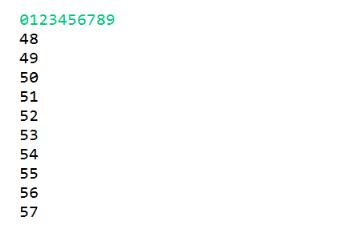
1. 我們可以通過將字符強(qiáng)轉(zhuǎn)為int型進(jìn)行輸出那么在控制臺(tái)中我們將會(huì)得到字符的ascii值,這里我們使用nextLine()方法來接收字符串,可以接收空格/Tab鍵,使用next()方法則不會(huì)接收空格/Tab鍵,但是這里使用nextLine方法不能打印回車鍵的ascii值因?yàn)樗龅交剀囨I就截止接收字符了
2. 具體的測試代碼如下:
import java.util.Scanner;public class Main { public static void main(String[] args) { Scanner sc = new Scanner(System.in); String s = sc.nextLine(); for(int i = 0; i < s.length(); i++){ System.out.println((int)s.charAt(i)); } sc.close(); }}
輸入:
0123456789
輸出:
補(bǔ)充知識(shí):Java Integer -128~127
今天刷到了一道題,為什么第一個(gè)為true,第二個(gè)為false。
System.out.println(Integer.valueOf('100')==Integer.valueOf('100'));//true
System.out.println(Integer.valueOf('200')==Integer.valueOf('200'));//false
研究源碼發(fā)現(xiàn)
/** * Returns a <tt>Integer</tt> instance representing the specified * <tt>int</tt> value. * If a new <tt>Integer</tt> instance is not required, this method * should generally be used in preference to the constructor * {@link #Integer(int)}, as this method is likely to yield * significantly better space and time performance by caching * frequently requested values. * * @param i an <code>int</code> value. * @return a <tt>Integer</tt> instance representing <tt>i</tt>. * @since 1.5 */ public static Integer valueOf(int i) { if(i >= -128 && i <= IntegerCache.high) return IntegerCache.cache[i + 128]; else return new Integer(i); }
private static class IntegerCache { static final int high; static final Integer cache[]; static { final int low = -128; // high value may be configured by property int h = 127; if (integerCacheHighPropValue != null) {// Use Long.decode here to avoid invoking methods that// require Integer’s autoboxing cache to be initializedint i = Long.decode(integerCacheHighPropValue).intValue();i = Math.max(i, 127);// Maximum array size is Integer.MAX_VALUEh = Math.min(i, Integer.MAX_VALUE - -low); } high = h; cache = new Integer[(high - low) + 1]; int j = low; for(int k = 0; k < cache.length; k++)cache[k] = new Integer(j++); } private IntegerCache() {} }
valueOf會(huì)將常用的值(-128 to 127)cache起來。當(dāng)i值在這個(gè)范圍時(shí),會(huì)比用構(gòu)造方法Integer(int)效率和空間上更好。
以上這篇Java中輸出字符的ASCII值實(shí)例就是小編分享給大家的全部內(nèi)容了,希望能給大家一個(gè)參考,也希望大家多多支持好吧啦網(wǎng)。
相關(guān)文章:
1. 什么是python的自省2. php模擬實(shí)現(xiàn)斗地主發(fā)牌3. 詳解Android studio 動(dòng)態(tài)fragment的用法4. jQuery 實(shí)現(xiàn)DOM元素拖拽交換位置的實(shí)例代碼5. MyBatis中的JdbcType映射使用詳解6. vue 使用localstorage實(shí)現(xiàn)面包屑的操作7. Vue封裝一個(gè)TodoList的案例與瀏覽器本地緩存的應(yīng)用實(shí)現(xiàn)8. Vuex localStorage的具體使用9. Python random庫使用方法及異常處理方案10. Docker 容器健康檢查機(jī)制
 網(wǎng)公網(wǎng)安備