PHP讀取和寫入CSV文件的示例代碼
目錄
- 1. 什么是 CSV 文件
- 2. 從 CSV 文件中讀取數(shù)據(jù)
- 3. 將數(shù)據(jù)寫入 CSV 文件
1. 什么是 CSV 文件
CSV(逗號分隔值)文件是使用逗號分隔信息的文本文件。該文件的每一行都是一條數(shù)據(jù)記錄,也就意味著它可以用于以表格的形式展現(xiàn)信息。
2. 從 CSV 文件中讀取數(shù)據(jù)
我將使用內(nèi)置函數(shù) file 從 CSV 文件中讀取數(shù)據(jù),然后使用 str_getcsv() 解析包含逗號的字符串。
在介紹如何使用str_getcsv() 函數(shù)之前,我想向你介紹如何輸出 CSV 文件中的數(shù)據(jù)。
<?php if($_FILES){var_dump(file($_FILES["file"]["tmp_name"], FILE_IGNORE_NEW_LINES | FILE_SKIP_EMPTY_LINES)); }?>?<html> <body><form method="post" enctype="multipart/form-data"> <input type="file" name="file" /> <button>upload</button></form> </body></html>當(dāng)我使用上面的代碼上傳文件時(shí),輸出以下數(shù)據(jù):
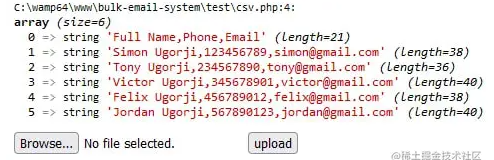
如圖所示,每個(gè)字符串中都有逗號,每個(gè)逗號將一條信息與另一條信息隔開。
使用 array_map() 函數(shù),并且 str_getcsv() 作為回調(diào)函數(shù),該回調(diào)將解析每個(gè)具有逗號的字符串并將它們分隔在一個(gè)數(shù)組中。
if($_FILES){ //loop through the csv file into an array $theCSV = array_map("str_getcsv", file($_FILES["file"]["tmp_name"], FILE_IGNORE_NEW_LINES | FILE_SKIP_EMPTY_LINES)); //dump result var_dump($theCSV);}輸出如下:
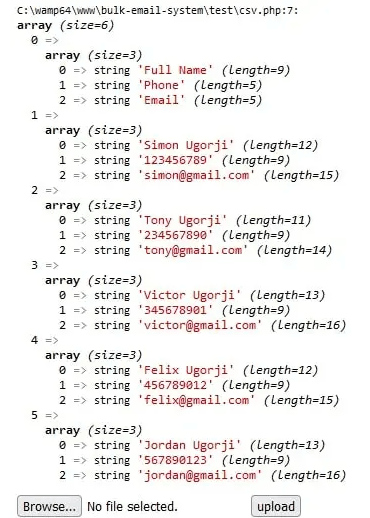
輸出的數(shù)據(jù)看起來比之前要好得多,我們將列標(biāo)題(全名、QQ、電子郵件)作為該數(shù)組的第一個(gè)元素。
我們使用 array_walk() 函數(shù)遍歷此數(shù)組 ,然后提供一個(gè)回調(diào)函數(shù),它將列標(biāo)題(全名、QQ、電子郵件)和每個(gè) CSV 數(shù)據(jù)組合為一個(gè)新數(shù)組。
if($_FILES){ //loop through the csv file into an array $theCSV = array_map("str_getcsv", file($_FILES["file"]["tmp_name"], FILE_IGNORE_NEW_LINES | FILE_SKIP_EMPTY_LINES)); /*Walk through the array and combine the headers which is the first element of our csv array with the rest of the csv data*/ array_walk($theCSV, function(&$ary) use($theCSV) {$ary = array_combine($theCSV[0], $ary); }); //dump result var_dump($theCSV);}?>注意,在上面的回調(diào)函數(shù)中,我使用了變量& 運(yùn)算符將 $ary 通過引用傳遞給函數(shù),這使的我們可以修改原始數(shù)組。當(dāng)我們運(yùn)行上面的代碼時(shí),這就是我們的 CSV 數(shù)組現(xiàn)在的樣子:
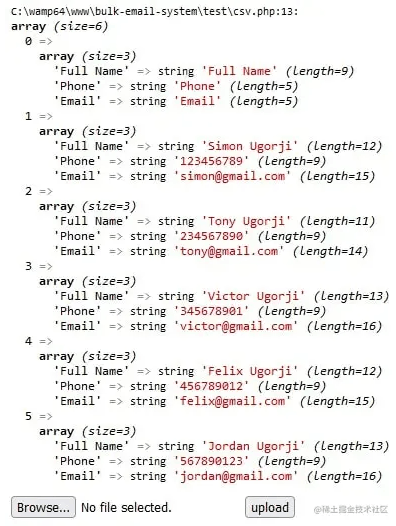
注意這里有個(gè)問題:這個(gè)新數(shù)組的第一個(gè)元素是表頭,因?yàn)槲覀冎白屗c CSV 數(shù)組的其他數(shù)組組裝在了一起。可以使用 array_shift() 來解決這個(gè)問題。
if($_FILES){ //loop through the csv file into an array $theCSV = array_map("str_getcsv", file($_FILES["file"]["tmp_name"], FILE_IGNORE_NEW_LINES | FILE_SKIP_EMPTY_LINES)); /*Walk through the array and combine the headers which is the first element of our csv array with the rest of the csv data*/ array_walk($theCSV, function(&$ary) use($theCSV) {$ary = array_combine($theCSV[0], $ary); }); //remove column headers which is the first element array_shift($theCSV); //dump result var_dump($theCSV);}這就是我們最終的 CSV 數(shù)組的樣子
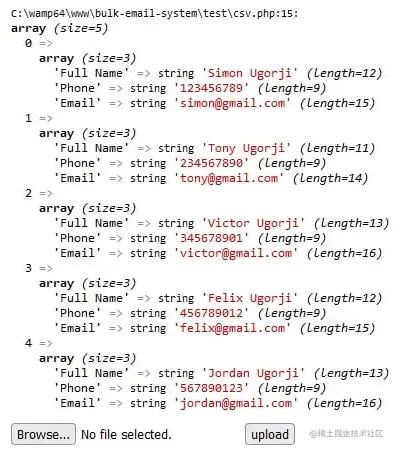
將上面的代碼封裝成一個(gè)函數(shù),如下:
function readCSV($file){ if(empty($file) || !file_exists($file)) return; //store the column headers $headers = null; $theCSV = array_map("str_getcsv", file($file, FILE_IGNORE_NEW_LINES | FILE_SKIP_EMPTY_LINES)); /*Walk through the array and combine the headers which is the first element of our csv array with the rest of the csv data*/ array_walk($theCSV, function(&$ary) use($theCSV, &$headers) { $ary = array_combine($theCSV[0], $ary); //store the headers $headers = $theCSV[0]; }); //remove column headers which is the first element of our csv array array_shift($theCSV); //return data return array("headers" => $headers,"data" => $theCSV );}3. 將數(shù)據(jù)寫入 CSV 文件
將數(shù)據(jù)寫入 CSV 文件,其邏輯是使用 fopen() 函數(shù)以附加模式打開 CSV 文件, 然后用 fputcsv() 解析我們要寫入 CSV 文件的數(shù)據(jù),然后此方法將這些數(shù)據(jù)寫入文件流當(dāng)中。
if($_SERVER["REQUEST_METHOD"] == "POST"){ $file = "./my_csv_file.csv"; //loop through the csv file into an array $csvData = readCSV($file); //create array to store the new data $newData = []; //loop through headers and then add values as a new array foreach($csvData["headers"] as $index => $key){if($key == "Full Name"){ $newData[$key] = $_POST["full_name"];}elseif($key == "Email"){ $newData[$key] = $_POST["email"];}elseif($key == "Phone"){ $newData[$key] = $_POST["phone"];}else{ $newData[$key] = "";} } var_dump($newData);}如圖所示就是我們將寫入到 CSV 文件的數(shù)組的數(shù)據(jù)
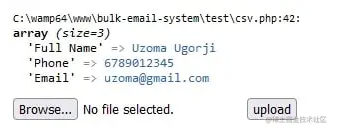
在我們將這些數(shù)據(jù)寫入到 CSV 文件之前,我們必須去掉 key,我們可以使用 array_values() 函數(shù)
if($_SERVER["REQUEST_METHOD"] == "POST"){ $file = "./my_csv_file.csv"; //loop through the csv file into an array $csvData = readCSV($file); //create array to store the new data $newData = []; //loop through headers and then add values as a new array foreach($csvData["headers"] as $index => $key){if($key == "Full Name"){ $newData[$key] = $_POST["full_name"];}elseif($key == "Email"){ $newData[$key] = $_POST["email"];}elseif($key == "Phone"){ $newData[$key] = $_POST["phone"];}else{ $newData[$key] = "";} } //open the csv file as in append mode $fp = fopen($file, "a+"); //remove keys from new data $newData = array_values($newData); //append data to csv file fputcsv($f, $newData); //close the resource fclose($fp);}不出意外的話,數(shù)據(jù)就會(huì)成功寫入到 CSV 文件當(dāng)中去了。
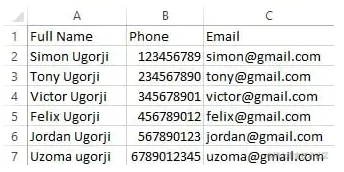
以上就是PHP讀取和寫入CSV文件的示例代碼的詳細(xì)內(nèi)容,更多關(guān)于PHP CSV文件的資料請關(guān)注其它相關(guān)文章!
 網(wǎng)公網(wǎng)安備