MYSQL使用Union將兩張表的數(shù)據(jù)合并顯示
union:用于連接兩個(gè)以上的 SELECT 語(yǔ)句的結(jié)果組合到一個(gè)結(jié)果集合中。多個(gè) SELECT 語(yǔ)句會(huì)刪除重復(fù)的數(shù)據(jù)。
使用union操作符會(huì)將多張表中相同的數(shù)據(jù)取值一次,如果想將表1和表2中的值完整的顯示出來(lái),可以使用union all。
演示小伙伴們自行創(chuàng)建一下表。
表1數(shù)據(jù)如下:

表2數(shù)據(jù)如下:
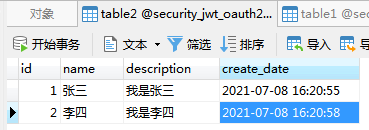
OK,表數(shù)據(jù)已經(jīng)創(chuàng)建完成,一共五條數(shù)據(jù),接下來(lái)我們?nèi)タ匆豢磚nion 和 union all 的使用。
使用union 看一下效果:
select t1.id id, t1.name name, t1.description description,t1.create_time time from table1 t1UNIONselect t2.id id, t2.name name, t2.description description,t2.create_date time from table2 t2
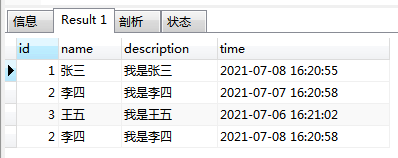
我們可以看到使用union只會(huì)查出來(lái)四條數(shù)據(jù)。其中兩條是相同的數(shù)據(jù),則顯示一條。
使用union all 看一下效果:
select t1.id id, t1.name name, t1.description description,t1.create_time time from table1 t1UNION ALLselect t2.id id, t2.name name, t2.description description,t2.create_date time from table2 t2
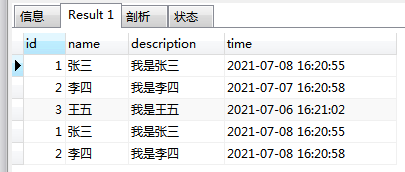
使用union all查出5條數(shù)據(jù),ps:相同的數(shù)據(jù)也會(huì)查詢出來(lái)。
拓展:為了區(qū)分哪張表中的數(shù)據(jù),我們可以這樣做
select t1.id id, t1.name name, t1.description description,t1.create_time time,’table1’ type from table1 t1UNION ALLselect t2.id id, t2.name name, t2.description description,t2.create_date time,’table2’ type from table2 t2
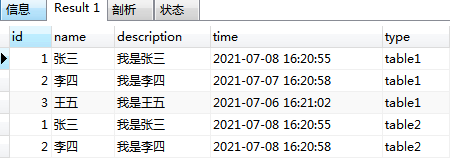
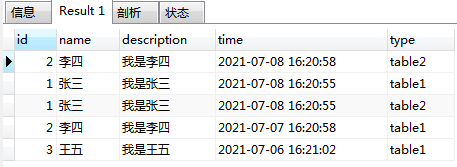
將兩張表中的數(shù)據(jù)按時(shí)間排序
select t3.* from (select t1.id id, t1.name name, t1.description description,t1.create_time time,’table1’ type from table1 t1UNION ALLselect t2.id id, t2.name name, t2.description description,t2.create_date time,’table2’ type from table2 t2) t3 order by t3.time desc
到此這篇關(guān)于MYSQL使用Union將兩張表的數(shù)據(jù)合并顯示的文章就介紹到這了,更多相關(guān)mysql數(shù)據(jù)合并顯示內(nèi)容請(qǐng)搜索好吧啦網(wǎng)以前的文章或繼續(xù)瀏覽下面的相關(guān)文章希望大家以后多多支持好吧啦網(wǎng)!
相關(guān)文章:
1. MySQL分區(qū)的優(yōu)點(diǎn)2. mysql的like模式3. mysql-bin.000001文件的來(lái)源及處理方法4. MYSQL(電話號(hào)碼,身份證)數(shù)據(jù)脫敏的實(shí)現(xiàn)5. MySQL 字符串函數(shù):字符串截取6. 加密你的Access數(shù)據(jù)庫(kù)asp打開(kāi)方法7. mysql like語(yǔ)句問(wèn)題8. Oracle根據(jù)逗號(hào)拆分字段內(nèi)容轉(zhuǎn)成多行的函數(shù)說(shuō)明9. 什么是Access數(shù)據(jù)庫(kù)10. 如何實(shí)現(xiàn)MySQL數(shù)據(jù)庫(kù)的備份與恢復(fù)

 網(wǎng)公網(wǎng)安備